 Hyla cinerea (Green Tree Frog) hanging out with Pontederia cordata (Pickerel Weed) in Historic Blakely State Park. Pickerel weed is a vigorous, deciduous, emergent marginal aquatic perennial that typically grows 2-4’ tall. It is native to quiet waters at stream and pond margins from Nova Scotia south to Florida and Alabama. In the wild, it is frequently seen growing in dense colonies. Glossy, narrow, arrowhead-shaped green leaves (to 10” long) have rounded cordate bases and rise well above the water surface. Tiny, tubular soft blue flowers are densely packed into erect, 3-6” long spikes atop flower stalks typically rising 1-2’ above the water surface. Plants flower freely from late May to October. Flowers give way to starchy seeds with distinctive toothed ridges. Flower spikes droop after bloom, releasing the distinctive seeds into the water. Seeds are edible off the plant or can be dried and added to granola cereals. Dragonflies and damselflies commonly lay their eggs on plant stems near the water surface.
Thursday, June 08, 2006
Hyla cinerea (Green Tree Frog) hanging out with Pontederia cordata (Pickerel Weed) in Historic Blakely State Park. Pickerel weed is a vigorous, deciduous, emergent marginal aquatic perennial that typically grows 2-4’ tall. It is native to quiet waters at stream and pond margins from Nova Scotia south to Florida and Alabama. In the wild, it is frequently seen growing in dense colonies. Glossy, narrow, arrowhead-shaped green leaves (to 10” long) have rounded cordate bases and rise well above the water surface. Tiny, tubular soft blue flowers are densely packed into erect, 3-6” long spikes atop flower stalks typically rising 1-2’ above the water surface. Plants flower freely from late May to October. Flowers give way to starchy seeds with distinctive toothed ridges. Flower spikes droop after bloom, releasing the distinctive seeds into the water. Seeds are edible off the plant or can be dried and added to granola cereals. Dragonflies and damselflies commonly lay their eggs on plant stems near the water surface.

Tuesday, June 06, 2006
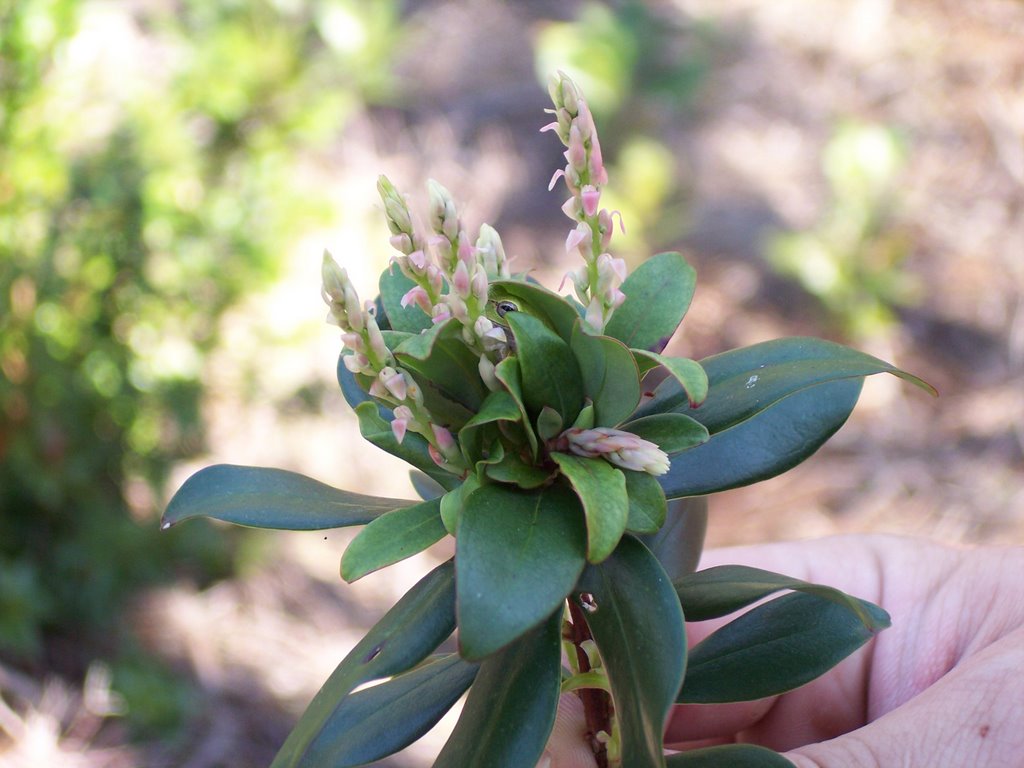
 Kalmia hirsuta (Hairy Wicky) is one of my new favorite names in botany. This shrub is one that is not common and was once state listed as threatened by Alabama. I love the common name of this plant. Hairy Wicky...why do I like it so much?? I do not know. Closely related to Kalmia latifolia (Moutain Laurel - see previous postings for image) a more common shrub in northern Alabama, this shrub is much less likely to be encountered and is typically only a coastal plain species.
Thursday, June 01, 2006
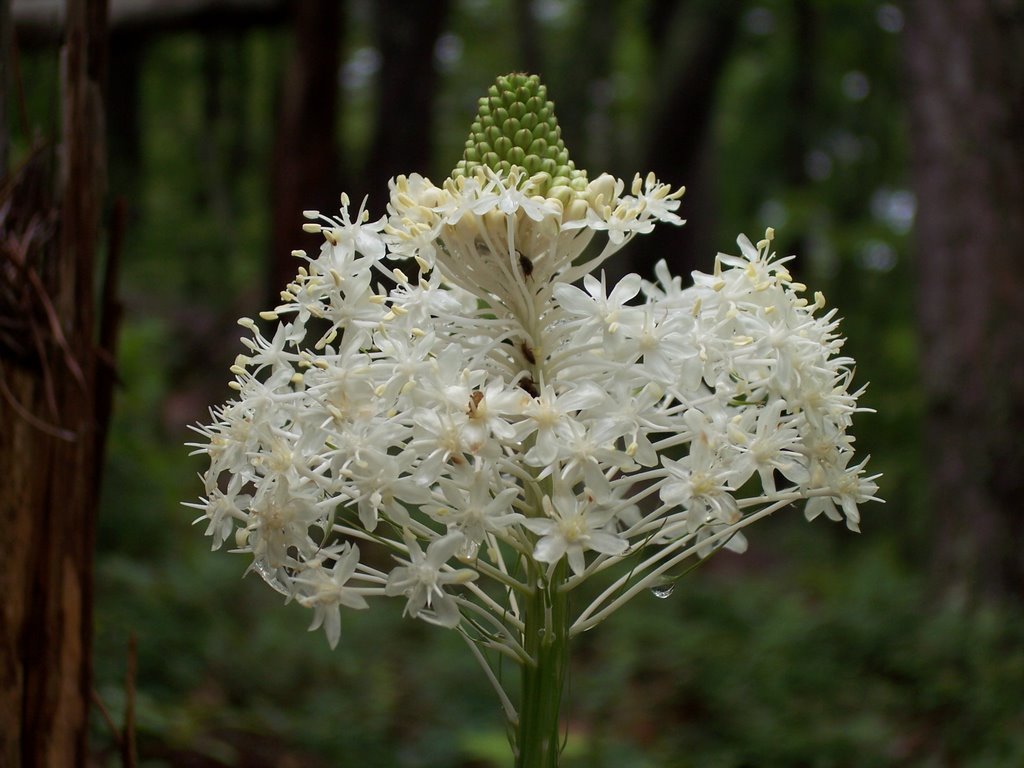
Turkey Beard (Xerophyllum asphodeloides) has dense clusters of creamy, star-like flowers that bloom from May to July. Flowering on stalks two to four feet high, they are tough, elegant members of the lily family. The mostly basal leaves are thin (grass-like), elongated and up to two feet long. They form a tussock at the base of the plant. The genus name, xerophyllum, is from the Greek words xeros ("dry") and phyllon ("leaf") and refers to the dry, wiry leaves that compose that tussock.
NatureServe, a non-profit conservation organization, reports that they are ranked "vulnerable" in North Carolina and Tennessee. They are ranked as critically imperiled in South Carolina, Georgia, and Alabama. They are believed to have been extirpated from Delaware and perhaps from Kentucky.
I found this new population of Turkey Beard on the Shoal Creek Ranger District of the Talladega National Forest (near Heflin, AL.) Known populations were documented from the area, but on opposing ridgetops a quarter of a mile away.
Wednesday, May 24, 2006

The man who standardized the naming system for plants, Carl Linnaeus, named Mountain Laurel (Kalmia latifolia) after a student of his, Peter Kalm. Peter Kalm came to our country in 1753 looking for plants to take back to Europe. In mountainous/hilly north Alabama, it can grow into a beautiful large shrub that is tolerant of many conditions. The intricate flowers of mountain laurel have a specialized stamen that ejects pollen when "tripped" by a bee.
Tuesday, May 23, 2006
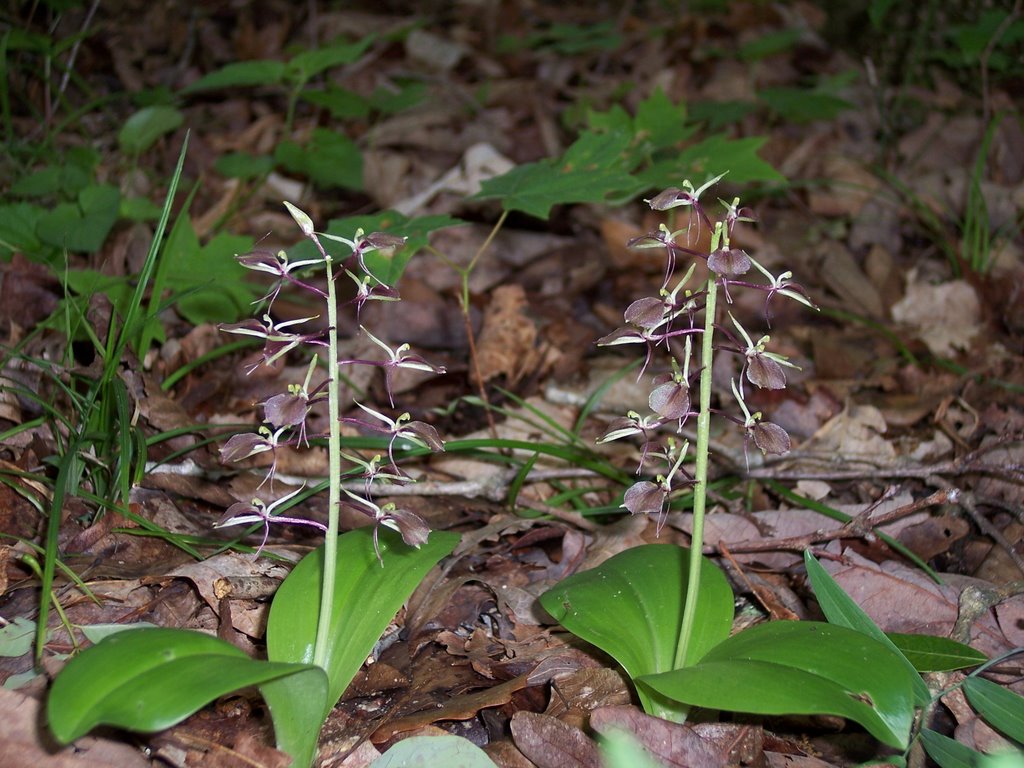
Lily-leafed Twayblade (Liparis lilifolia) is a rare orchid to find in Alabama. In fact, it is only known from a handful of sites in the northern part of the state. The botanical name is from a Greek word meaning "fat," from the succulence of the leaves. "Liparis," from Greek "liparos," fat or shining, from the smooth and lustrous leaves and succulence. "lilifolia," lily-leaved. Note the broad paired basal leaves and the dull mauve flowers with their broad lip, threadlike side petals and narrow greenish sepals. 4-10 in. Truly a beauty that is easily overlooked.
Monday, May 22, 2006
 Tree-of-Heaven (Ailanthus altissima) is native to Asia, and began its journey west by being introduced to Europe in 1751 by a French Jesuit preist who brought it from Nanking, China to England. The first known specimen was brought into the United States a few decades later by William Hamilton, who planted this species in Philadelphia. People admired the beautiful foliage of these fast-growing trees, and for over a century have been planting it as an ornamental, although the leaves emit a foul-smelling odor.
Sunday, April 23, 2006

Southern Red Trillium (Trillium sulcatum) is also known as Barksdale's Trillium and offically as Furrowed Wakerobin. This is a herbaceous plant, it is a perennial which can reach 40cm in height (16inches). The leaves are whorled. Each of the three leaves is entire. The flowers have 3 Regular Parts and are up to 7cm wide (2.75 inches). They are rich burgandy or red. Blooms first appear in mid spring and continue into late spring. The flower is on a long pedicel to 10cm (4"). The petals are cupped at the base spreading beyond the ovary. Odor not particularly unpleasant. Its habitat is rich moist woods, ranging from West Virginia south to north west Georgia and north east Alabama. Mostly in gorges of the Cumberland Plateau.
Saturday, April 22, 2006

The classification of the yellow lady's-slipper orchids has not been settled. Formerly, they were considered to be the same species as Eurasian yellow lady's-slippers -- Cypripedium calceolus. The modern trend is to separate the American plants from the Eurasian, but the number of American species is under debate. Some botanists recognize two species in northeastern U.S. -- Cypripedium parviflorum and Cypripedium pubescens, but these species are defined differently by different authorities. Following the Flora of North America, it is best classified as Cypripedium parviflorum it is classified as a species of special concern in Alabama.
Wednesday, April 05, 2006

Tuesday, March 21, 2006

Monday, March 20, 2006
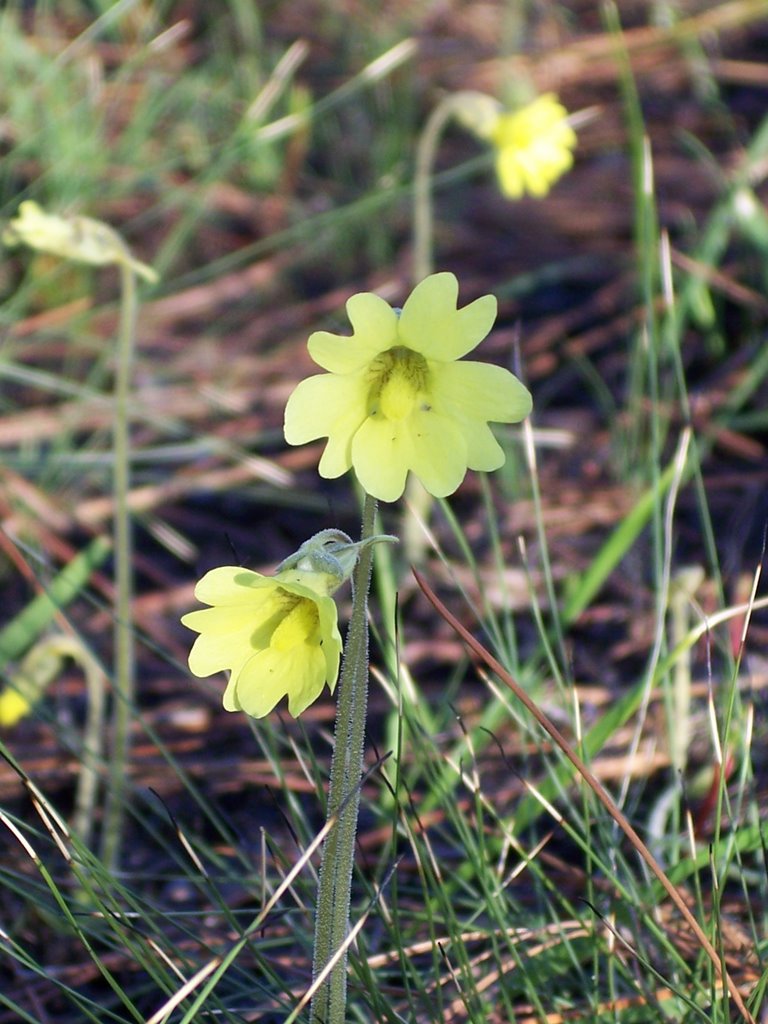 This Carnivorous (insectivorous) plant consists of a small rosette of yellowish-green leaves with upturned margins. The flypaper method of capture is employed whereby the insect becomes mired down in the mucilage which covers the leaves. The margins may slowly enfold the animal over a period of time, after which, enzymes are released which begin the digestive process. Pinguicula lutea is a member of the Lentibulariaceae - Bladderwort family.
Tuesday, March 14, 2006

Saturday, March 11, 2006
Friday, March 03, 2006

Though not really a rare plant, I only recently saw Goldenclub (Orontium aquaticum) blooming for the first time. This picture was taken in Baldwin County, AL. Golden club is a medium sized immersed plant. It grows from stout rhizomes in the mud of shallow waters. Its leaves are usually out of the water, but often are floating. Golden club has dark green, velvety leaves, which have a water repellant surface. Leaves are two to four inches wide and six to 12 inches long. They are oblong-eliptic. Leaves grow in groups and emerge from the water on stalks. Golden clubs are named for the shape of their flower clusters. Many tiny yellow flowers grow at the tip of a club-shaped structure. The club is on a stalk that arises separately from the leaves.
Thursday, March 02, 2006

I found these sundews (Drosera intermedia - Spoonleaf Sundew) growing in a ditch down in Lillian, AL. The swamp is literally covered in sundews of two species: D. intermedia and D. capillaris. They are so charismatic, that it is hard not to love these plants...this makes walking in the swamp sometimes very difficult. Not from all the muck, but from trying not to kill the plants by stepping on them.
Sunday, February 26, 2006
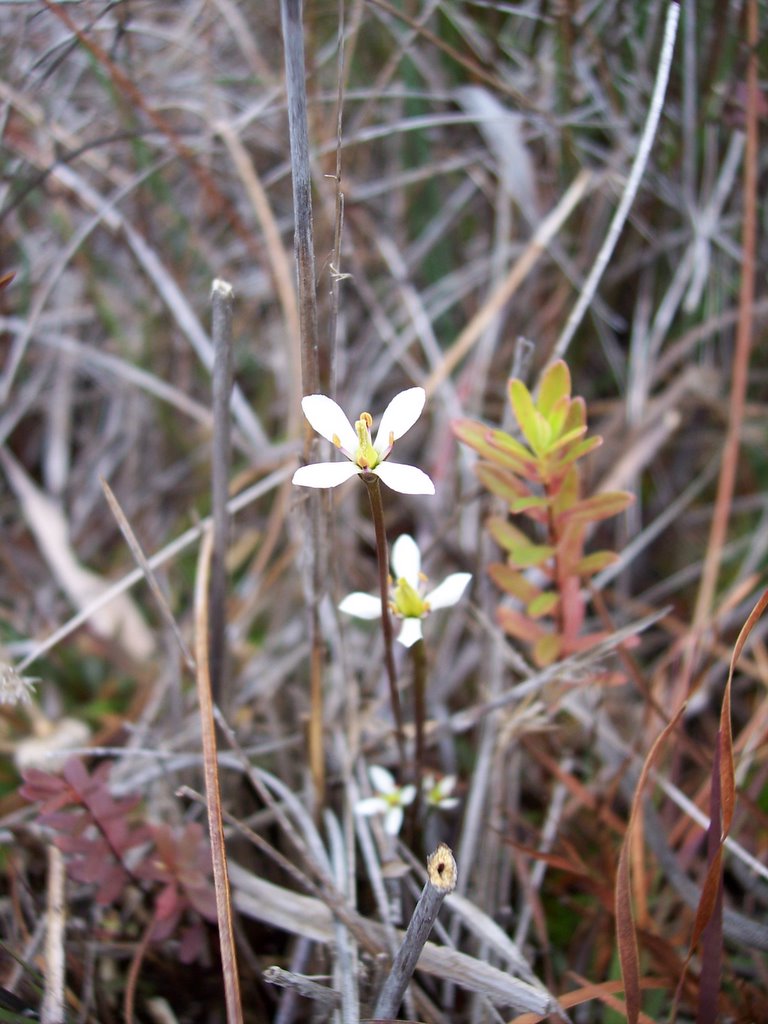
This is one of my "new favorites." I was not familiar with Bartonia verna (White Screwstem) until just a few weeks ago. It actually stumped me for a long while, but I finally placed it in the Gentian family. It is an early bloomer from the coastal plain. I think I took this picture during the third week of January. I even found one flower that had parts that were five-meric instead of the normal four.
Friday, February 24, 2006

Monday, February 20, 2006

Sunday, February 05, 2006

Keeping with my unintentional "survey of all kingdoms from Lillian Swamp" I am posting a picture of Ophrydium. Ophrydium versatile is a sessile ciliate from Kingdom Protista that forms green, gelatinous colonies. Chlorophyll a and b impart a green color to Ophrydium masses due to 400-500 Chlorella-like endosymbionts in each peritrich. Translation: These are slimy balls made up of a bunch of smaller organisms that are green. They do not indicate water quality issues, rather they act much like tiny water filters.
Thursday, February 02, 2006
 Amphiuma means
I found this guy eating chicken liver from a minnow trap that we put out for fish inventories in Lillian Swamp. I guess he was hungry! The Two-toed Amphiuma is a large, eel-like aquatic salamander that can reach maximum length up to 3 feet or more. All four limbs are present, but extremely tiny, and there are only two toes on each. They are black to dark brown with a dark gray belly. All Amphiumas undergo an incomplete metamorphosis (transformation from larva to adult), retaining one of the three gill slits and never developing eyelids. The number of twos distinguishes the three species of Amphiuma, but you have to catch one to be able to count them. They can also be differentiated on the basis of coloration and body size.
Subscribe to:
Posts (Atom)